|
|
|
|
The 1650's in England was the time of the Puritan Commonwealth. The Puritans
objected to entertainments that they deemed frivolous or likely to distract a
person from righteousness. Dancing in the courtly fashion was one such activity.
Dancing was not wholly forbidden but "mixed dancing", where men and women touched
while dancing was prohibited. The style changed, therefore, to "country dances" -
line or square dances where touching was at a minimum.
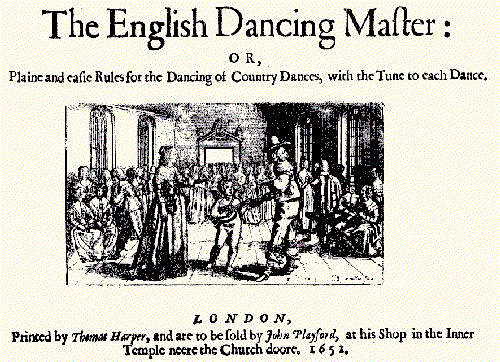
In 1651, music publisher John Playford published The English Dancing Master, a book of tunes and instructions for the new style of country dancing. The tunes were mostly drawn from old ballad tunes. There is a good analysis of this in William Chappell's Popular music of the Olden Time. John Playford (1623-1686) was a successful London music publisher. A royalist, he kept a low profile during the Commonwealth and came into political favor with the return of Charles II. He catered to the taste of the emerging bourgeois class which preferred country dancing to the more formal galliards and other formal dances popular with the nobility before the Civil War. The following year Playford produced a second edition which was titled simply The Dancing Master. Successive editions were published by John Playford until his retirement in 1684 when publication was taken over by his son Henry who supervised the printing of the seventh and subsequent editions until it came under the management of John Young at the 14th edition of 1709. Under Young's editorship the next few editions were the most accurate of any then printed. John Young published several additional editions, usually referred to as Volume 2 and Volume 3 in 1714 and 1718. The tunes are not exactly traditional music. They were popular music intended for an urban audience. The various editions of The Dancing Master were updated with the hits of the day, songs from popular plays and special music used by professional dancers. A number of the tunes can be found in traditional circulation but whether this was true before or after the publication is undetermined. English country dancing is first mentioned in the Elizabethan period. Some of the tunes were probably at least 100 years old when they were published. Many of the older tunes existed as songs rather than strictly dance tunes. My selections in this sections are a bit eclectic - there are some tunes that are my personal favorites, some are tunes that I have found interesting in performance by various groups and some that caught my attention for their quirky titles and that turned out to be interesting tunes. Jeremy Barlow's The Complete Country Dance Tunes from Playford's Dancing Master is an excellent compendium of all the tunes, versions and editions published in editions 1 - 17. Tunes published in Young's Volume 2 and Volume 3 are not included. A summary of the publication history of the Dancing Master follows. The tune numbers refer to Barlow's numbering.
|