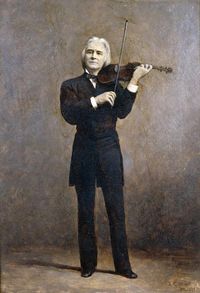
The tune is named for the Norwegian violinist Ole Bornemann Bull (1810-1880). At the age of four or five, he could play all of the songs he had heard his mother play on the violin. At age nine, he played first violin in the orchestra of Bergen's theatre and was a soloist with the Bergen Philharmonic Orchestra. He was eventually successful in becoming a high-level virtuoso, giving thousands of concerts. In England these included 274 performances in 1837 alone. He is believed to have composed more than 70 works, but only about 10 are known today. He performed in the United States in 1843 and returned four more times to North America to tour, playing mainly his own compositions and Norwegian folk music. There is a large bronze statue of Ole Bull playing his violin in Loring Park in Minneapolis, Minnesota, showing the influence not only of Bull but of thousands of Scandinavian immigrants to the region.
In the first year, up to 700 immigrants settled and tried to establish new homes there, roads were created and a sawmill and other facilities were built. However, already after one year, the settlers realized that it was not possible to make a living because of the poor soil and they moved on, many to Wisconsin.
The tune was printed in Ford's Traditional Music in America (1940), Howe's 1000 Jigs and Reels (c. 1867) (includes contra-dance directions), Phillips' Traditional American Fiddle Tunes, vol. 2 (1995) and White's Unique Collection (1896).
It was recorded by James Bryan on Lookout Blues (1983).