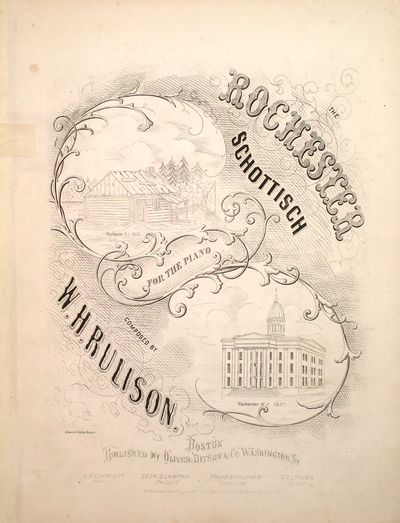
Seattle fiddler and musicologist Vivian Williams writes:
| “’Rochester Schottische’ was written in 1852 by William H. Rulison, who went to California for the Gold Rush, actually made some money (unlike most!), returned to his hometown of Rochester, NY, and opened up a music store”. |
| "Rulison was apparently a music master from upstate New York, for in one sheet music edition he dedicates the piece to his students in Buffalo and Rochester." |
Here is as much as I know about folk dancing:
|
The schottische is a partnered country dance that apparently originated in Bohemia.
It was popular in Victorian era ballrooms as a part of the Bohemian folk-dance
craze and left its traces in folk music of many countries including the United
States. The schottische is considered by The Oxford Companion to Music to be a
kind of slower polka, with continental-European origin.
The schottische basic step is made up of two sidesteps to the left and right, followed by a turn in four steps. In some countries, the sidesteps and turn are replaced by Strathspey hopping steps. |